
研究要旨
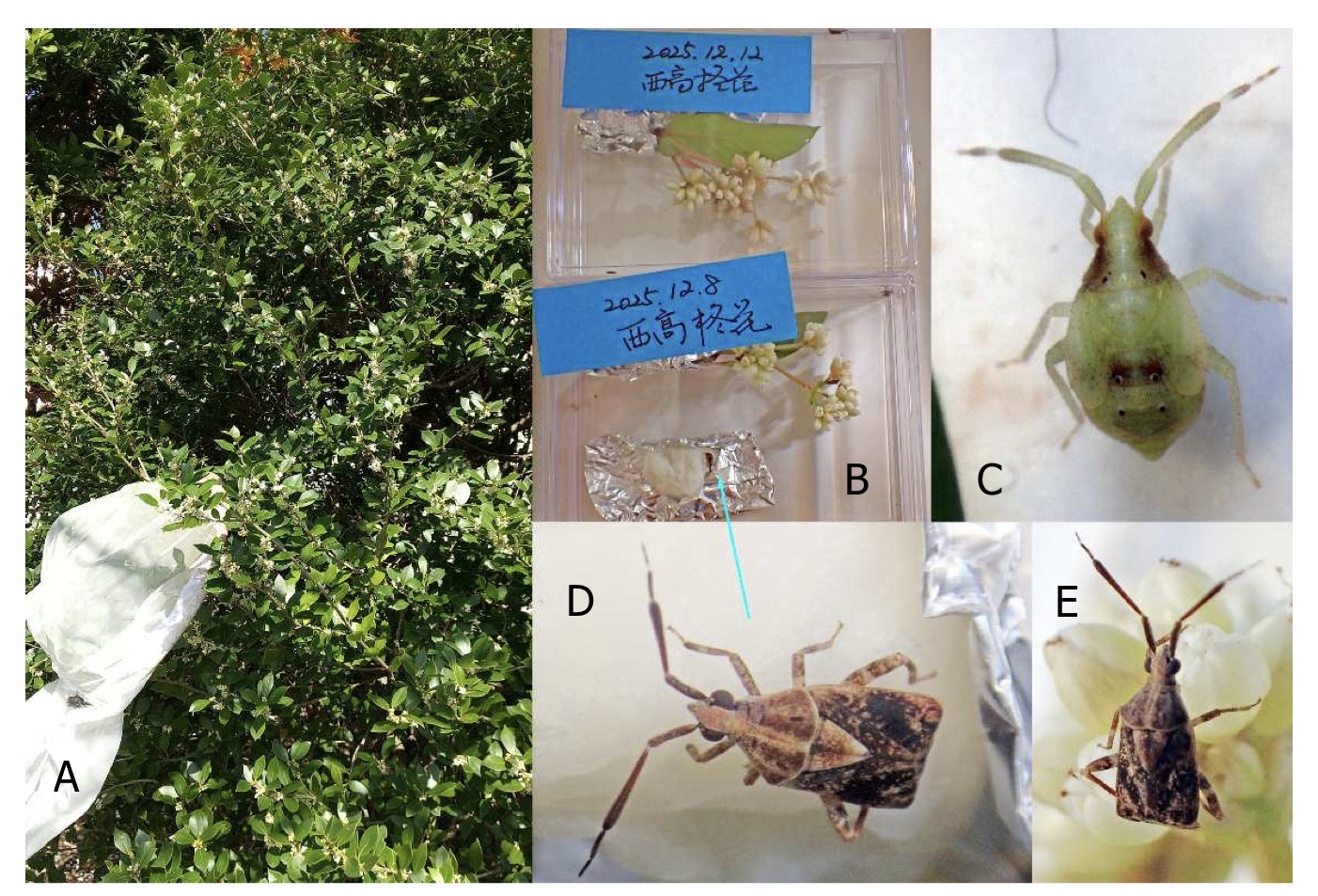
最近,西日本の市街部・都市部を含む平地において,かつて冬季には見られなかったカメムシ類の,12 月以降の冬期採集事例が増加傾向にある(安永ら 2018;福田ら 2021;橋口ら 2021;安永 2021)。ここ数年間,長崎西高等学校生物部の代々研究メンバーを中心に,長崎市内における冬期間の昆虫調査を不定期に実施してきたが,本 2025 年度,長崎西高校構内で 12 月に開花するヒイラギ Osmanthus heterophyllus の花穂に,カスミカメムシ類が集まって活動を続けていることを確認した。これらの中で,注目すべきものがタイワンメンガタカスミカメ Eurystylus ryukyus Yasunaga, Nakatani & Chérot, 2017 である。本種は亜熱帯起源で今世紀になって九州本土や四国南岸に分布を拡大したとされるが(Yasunaga et al. 2017),温帯域で 12 月に幼虫を含む多くの個体が見られるのは,明らかに地球温暖化や都市化(ヒートアイランド現象)によるものと考えられる。本文では,これらの冬季発生について考察するとともに,室内で飼育を試みたところ 2 ヶ月近く生存し,適当な温度が保たれれば世代を繰り返しうる可能性も示唆されたので報告したい。
著者
立石 みず樹・深堀 愛彩・安永 智秀・長嶋 哲也
Title
Winter occurrences of Eurystylus ryukyus (Insecta: Heteroptera: Miridae) at urbanized zone of Nagasaki City, Japan: Evidence for global warming
Abstract
The winter occurrence of Eurystylus ryukyus Yasunaga, Nakatani & Chérot, 2017 (Miridae: Mirinae) is reported. Although this thermophilic mirine, considered to be originated from subtropics, has not been collected in winter season within temperate climatic zones of Kyushu, Japan, we confirmed a number of the adults and nymphs were occurring on inflorescences of Osmanthus heterophyllus (G.Don) P.S.Green (Oleaceae). The phenomenon is in all likelihood attributed to global warming. We also attempted to rear both adults and a final instar nymph of the mirid and found that Eurystylus ryukyus has a potential to survive even in winter if the temperature is kept at ≥10°C.
Author
Tateishi M., Fukahori A., Yasunaga T. & Nagashima T.